

Santa Marta sits where the Sierra Nevada drops into the Caribbean, so its beaches run the full range: busy city sand, calm resort bays, snorkelling coves you reach only by boat or on foot, jungle beaches you walk into, and a surf coast that runs east toward Palomino.
This guide covers 30 of them, one for every day of the month, ordered roughly south to north and then east along the coast from the Santa Marta International Airport.
The beaches in the city itself are not the reason why tourists come. The water off the main Santa Marta beaches is dirty because it is a working port city with a massive trash problem.
To find the good swimming and snorkelling, you have to get out to the coves, into Tayrona National Park, or up the coast toward Palomino.
Keep in mind that the best beaches in Tayrona National Park are best accessible by boat or a long hike in.
The common day trip is the coastal boat tour from Taganga or Santa Marta bay. It runs east and stops at Playa Cristal and Bahía Cinto, passing Taganga, Playa Grande, Bahía Concha, Chengue, Gairaca and Neguanje on the way. Sailboat tours do a slower version of the same coast.
The Tayrona hike-in beaches, from Cañaveral to Cabo San Juan, are a separate day. You enter the park at El Zaino, pay the entry fee and insurance, then walk. There’s no road and, except for Cabo San Juan, no boat.
The Santa Marta and El Rodadero strip
1. Bahía de Santa Marta
Best for: a sunset walk and a launch point.

The city’s main beach runs along the malecón in front of the old town, with El Morro island out in the bay. It’s a short walk from the historic centre, and hotels and restaurants back the sand.
The beach is busy and the water isn’t clean enough for a real swim. What it does well is the evening. The sunset behind El Morro is the best in the city, and the waterfront fills with people out walking.
Many boat tours leave from here, so you’ll probably pass through even if you don’t swim. Treat it as a base and a viewpoint rather than a beach day.
2. El Rodadero
Best for: convenience and families who want amenities.

A resort strip about 10 minutes south of the centre, backed by a wall of high-rises. It’s the most built-up beach in the area and the easiest to reach.
The water is shallow and calm, which suits kids, but it’s crowded and lined with jet skis, loungers and vendors. Clarity is poor, so it’s a sit-and-swim beach rather than a snorkel one.
Boats to Playa Blanca and Playa Lipe leave from the Rodadero shore, so it doubles as a departure point. Good if you want restaurants and shops right behind the sand.
3. Playa Blanca
Best for: an easy snorkel and swim close to the city.

Across Gaira bay from Rodadero, reached by a 10 to 15 minute boat, or a hot walk over the hill if you’d rather not pay for the launch.
The water is clearer than Rodadero’s, and there’s decent snorkelling around the rocks at the edges. A few beach restaurants sell fish and drinks, and it gets busy on weekends.
It works as an easy half-day: boat over in the morning, snorkel and swim, come back in the afternoon. It isn’t part of the big Tayrona boat tours.
4. Playa Lipe
Best for: a deserted, historic cove reached by boat or a long hike.

Playa Lipe sits between Santa Marta bay and El Rodadero, next to the neighbouring hamlet of Playa Blanca. You reach it by boat from the bay or from Rodadero in about 10 to 15 minutes. There’s a long overland trail too, but it’s rough and access on that side is restricted near the San Fernando battalion, so almost everyone arrives by water.
The beach is golden sand with deep water and strong surf, plus a natural sand slide down to the shore that people come for. There are no shops and no services, so bring your own food and water. It stays close to empty, which is the whole appeal.
Beside it stands the colonial Fuerte San Fernando, one of the forts that defended Santa Marta from pirates. Swim with care because of the surf. For now the lack of infrastructure and the permit needed to land have kept it wild, though the city has talked about opening it up to tourism.
5. Playa Salguero
Best for: lots of open space, sand volleyball and a beach-club day.

A long, open beach south of Rodadero, wider and less hemmed in by towers, with beach clubs at the southern end.
There’s room to spread out, which is the main draw, and the clubs rent loungers and serve food and drinks. The water can pick up chop and small surf.
You can swim, though watch the shore break on windier days. It’s a road-access city beach, not on the boat tours.
6. Bello Horizonte
Best for: a calmer resort-style day and sunsets.

Between Rodadero and the airport, fronted by newer apartments and hotels. It’s calmer and quieter than the main Rodadero strip.
Restaurants and beach clubs back the sand, and the sunsets here are good. The water isn’t clear, so it’s for sun and swimming rather than snorkelling.
Easy to reach by road and comfortable for a low-key day near your hotel. It isn’t a boat-tour stop.
7. Playa Inca Inca
Best for: a quiet escape near the city.
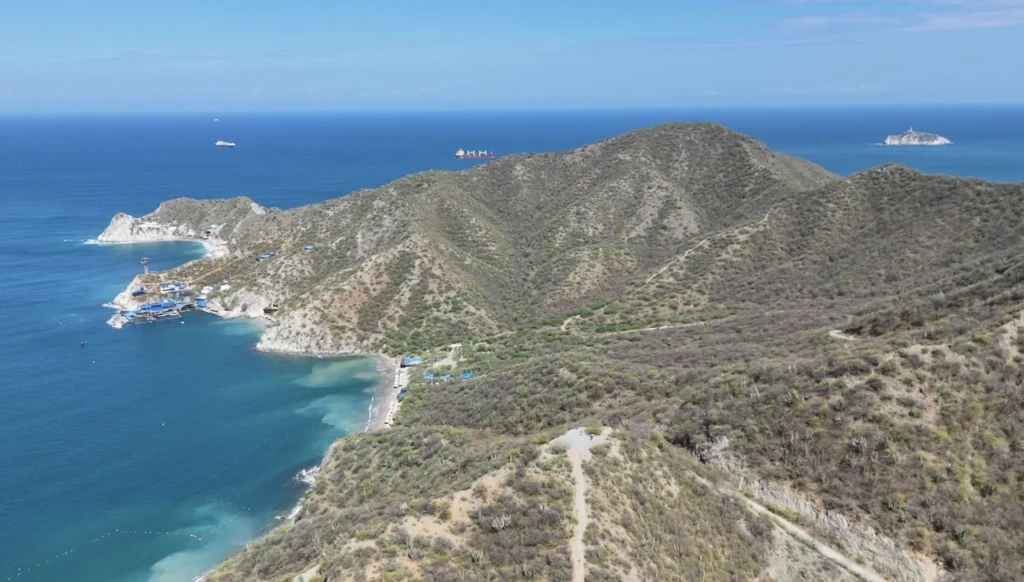
A small cove near Bello Horizonte that stays quieter than the main strip, with the Rodadero aquarium set into the same inlet.
Right next door, Playa Calderón is close to empty: no shops, no umbrellas, no vendors. It’s hard enough to reach that you’ll often have it to yourself.
Inca Inca is calm and swimmable. Calderón is a walk-in, off-grid spot with no services, so bring your own food and water and carry everything out. Neither is on the boat tours.
8. Pozos Colorados
Best for: resort guests and retirees wanting a quiet beach paradise.

The beach in front of the big resorts (Zuana, Estelar and others) south of Rodadero, near the airport.
It’s convenient if you’re staying at one of the hotels and fairly ordinary otherwise. The water isn’t the clearest along this stretch.
There’s space and calm water for a swim, with hotel amenities behind you. Road access only, and not a tour stop.
Taganga and its coves
9. Taganga
Best for: cheap diving, boats, snorkelling spots and hippe nightlife.

A fishing town about 15 minutes north of the city that grew into a backpacker and diving hub, set in a dry, hilly bay.
It has some of the cheapest PADI courses in Colombia, fresh seafood on the front, and a rough-edged, bohemian feel. The main beach itself is ordinary and crowds on weekends.
The real value is as a base. Boats leave from here for the coves and for Cabo San Juan, and the coastal snorkel hike starts from the village. Swim if you like, but the better water is a short walk or boat away.
10. Playa Grande
Best for: an easy half-day from Taganga and snorkelling.

Over the headland from Taganga, reached by a 15 to 25 minute coastal walk or a 5 to 15 minute boat.
The water is clearer than Taganga’s, restaurants sit right on the sand, and the snorkelling around the edges is good. It’s popular, so it fills up and gets loud with the bars.
It also sits on the coastal boat route and is the first beach you pass on the snorkel hike out to Sisiguaca and Momohuaca. Easy swimming and an easy day out.
11. Playa Sisiguaca and Playa Momohuaca
Best for: reef snorkelling you can reach on foot from Taganga.

These two coves are the snorkel hike from Taganga. Follow the coastal trail past Playa Grande and you reach Sisiguaca first, about 25 to 40 minutes’ walk, then Momohuaca a little further on, roughly an hour from the village in total. If you’d rather not hike, a boat runs from Taganga for around 25,000 pesos round trip, and kayak and paddleboard tours stop at both.
They’re the best snorkelling near the city that you can reach without a boat. Both are small and quiet, with clear green-blue water and reef close to shore, so you’re over fish and coral a few metres out. Sisiguaca is the busier of the two, and Momohuaca, being further, stays calmer. A rustic fisherman’s hut on each rents chairs, shade and snorkel gear, with cold beer and fresh fish when it’s open.
There’s little natural shade, so go early and bring an umbrella and water. The names come from the cosmology of the Kogi and related peoples of the Sierra Nevada: Sisiguaca is tied to water and origin, and Momohuaca is linked to the Mamos, their spiritual leaders. You’re snorkelling off land they hold sacred.
The Tayrona bays (boat or Palangana road)
12. Bahía Concha
Best for: a Tayrona beach without a hike, and camping.
The closest Tayrona bay to the city, about 35 to 45 minutes by road through the Palangana entrance, or reachable by boat.
It’s a wide, calm bay that Colombian families love on weekends. There’s camping on the sand but no shops, and the few restaurants charge a lot, so bring your own food.
The water is calm and good for swimming, and it’s usually open around 8am to 4pm. Boat tours pass it on the coastal route, and no hike is needed to reach it.
13. Gairaca and Chengue
Best for: snorkelling stops on a boat tour.
Two quieter bays between Concha and Neguanje, mostly seen from the water as the boat tours run east.
Both are less developed than the headline beaches, with reef that makes for good snorkelling where the boats anchor.
You’ll usually get them as brief stops or pass-bys rather than a full beach day. Access is by boat, with no hiking route most people use.
14. Neguanje
Best for: calm swimming and a base to reach Playa Cristal.
A large Tayrona bay reached by the Palangana road or by boat. It’s calm and pleasant in its own right.
Most people use it as the jumping-off point for the 10-minute boat hop across to Playa Cristal, but the bay itself is fine for a swim.
It’s on the coastal boat route, and the road in from Palangana can be rough. No hike is needed to reach the sand.
15. Playa Cristal (Playa del Muerto)
Best for: snorkelling.
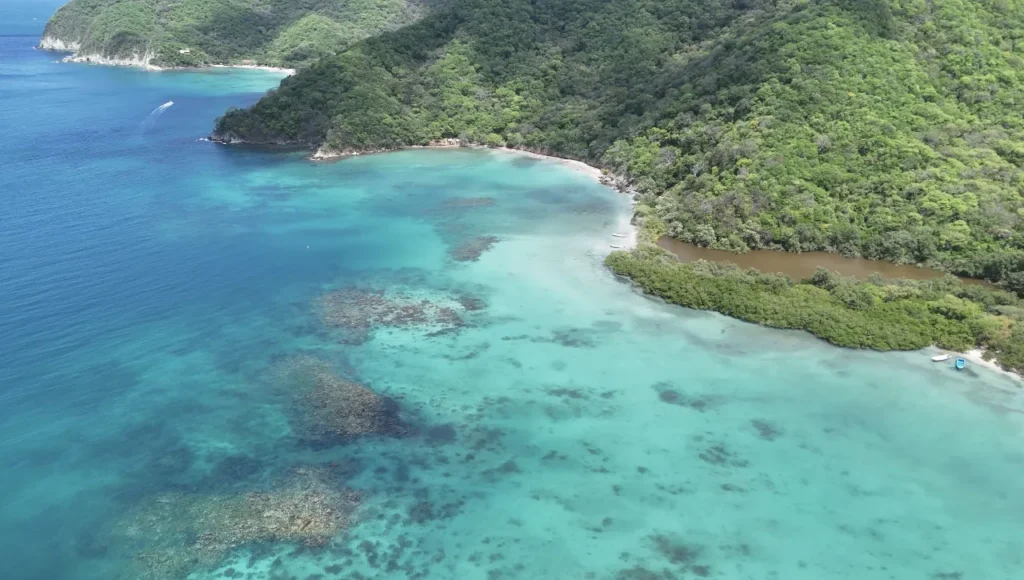
The snorkelling postcard of the area, tucked inside Neguanje bay. You reach it by a 10-minute boat from Neguanje, or a longer boat from Taganga or Santa Marta.
The water is clear and calm with corals close in, and rustic restaurants grill fish on the sand. Numbers are capped at around 300 people a day, so go early or book ahead.
This is the headline stop on the main boat tours. There’s no lodging and no overnight stays, and no hiking to get there, just the boat.
16. Bahía Cinto
Best for: a secluded snorkelling bay with almost nobody around.
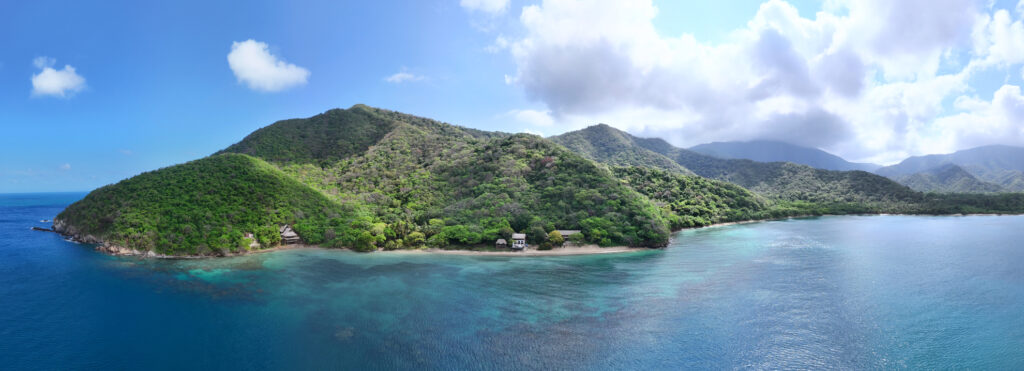
One of the most remote and least crowded bays in Tayrona. You reach it by boat from Santa Marta or Taganga, or by a jungle trail in from Neguanje. Because it’s hard to get to, it stays quiet even when the closer beaches are full.
The water is clear and calm, with reef for snorkelling and the classic Tayrona backdrop of jungle and green hills. It’s the far stop on the Cinto and Playa Cristal boat tour, so day-trippers usually get an hour or so on the sand.
A few exclusive stays sit around the bay for people who want to sleep out here in seclusion. If you’re choosing among the boat-tour beaches, Cinto is the one to pick for quiet over convenience.
17. Wachakyta (Playa Guachaquita)
Best for: an eco-lodge stay on a private, boat-access beach.
A secluded beach next to Cinto in the Calabazo sector, where the Wachakyta ecolodge sits right on the sand. You arrive by boat, or through the park toward Playa Guachaquita. Nothing drives up to the door, which is the point.
The beach is small and quiet, backed by jungle, with snorkelling on the nearby Cinto reef and trails leading out from the lodge. It suits a slow couple of days rather than a quick visit.
This is more a place to stay than a beach to drop into, so it fits a retreat or a honeymoon better than a day swim. Rooms and meals are at the lodge, and it’s small, so book ahead in season.
The hike-in beaches of Tayrona
You enter at El Zaino, pay the park fee and insurance, and walk. From Cañaveral it’s about 1.5 to 2 hours to Cabo San Juan, passing the other beaches on the way. The trail is well marked but humid and muddy in places. There’s no road to these, and no boat except to Cabo San Juan.
18. Cañaveral
Best for: the trailhead and the views.
The first beach inside Tayrona’s main sector, reached on foot after the El Zaino entrance. A shuttle covers the first stretch and saves about 45 minutes of walking.
Big waves and a strong current mean no swimming here. The setting is dramatic, with boulders and jungle, and the Ecohabs lodging sits above the beach.
Treat it as the start of the walk toward La Piscina and Cabo San Juan. It’s hike-in only, with no road to the sand and no boat.
19. Arrecifes
Best for: scenery and camping.

One of the biggest beaches in the park, a wide, wild stretch where jungle runs down to grey boulders, about 30 to 40 minutes past Cañaveral.
Do not swim here. The current has killed more than 100 people, and the ban is enforced for good reason. There’s a well-kept campsite back from the sand.
Come for the scale and the scenery, and to camp if you’re breaking the hike over two days. It’s hike-in only.
20. La Piscina
Best for: swimming and snorkelling.
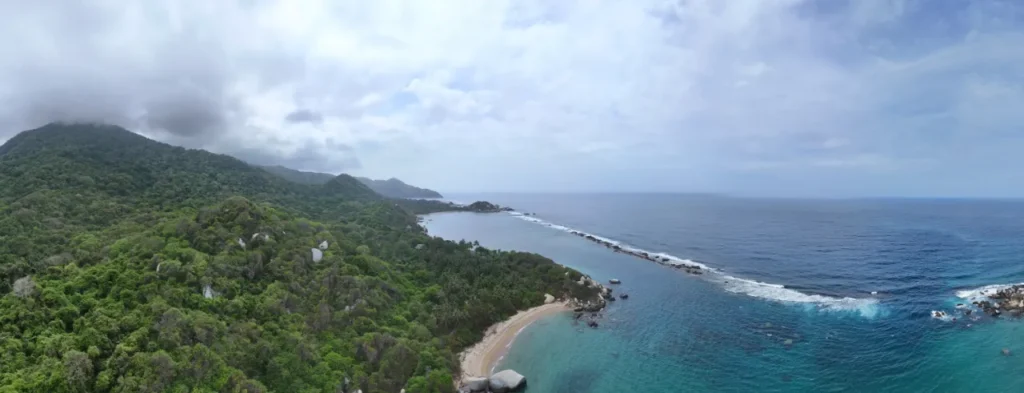
A reef-sheltered cove past Arenilla, and the best swimming on the walk-in route. The reef offshore breaks the waves and keeps the water calm.
Because it sits just before Cabo San Juan, it stays quieter, and the snorkelling over the rocks is good. If you only want to get in the water once on this hike, do it here.
There’s shade under the trees but no real services, so carry water and snacks. Hike-in only, roughly 1.5 hours from Cañaveral.
21. Cabo San Juan del Guía
Best for: the classic Tayrona day or overnight.

The iconic image of Tayrona: two bays split by a sand spit that ends in a hut on a rock. It’s about 1.5 to 2 hours’ walk from Cañaveral, or a 45-minute boat from Taganga.
Swimming is allowed, and there’s a restaurant, showers and a camping area with hammocks and tents. It’s the busiest beach in the park, so it can feel packed by midday.
Come before noon, or stay the night to have it quiet at dawn. Hammocks and tents can’t be booked online and sell out in high season, so sort them at the entrance desk. Reachable on foot or by boat.
22. Playa Nudista (Boca del Saco)
Best for: privacy.
About 15 minutes’ walk past Cabo San Juan, a nudist beach that stays quiet thanks to its reputation.
It’s wild and calm, with few people, which is the appeal if you want space away from the Cabo crowds.
Check conditions locally before swimming, and bring your own water and food. It’s hike-in only.
23. Playa Brava
Best for: solitude and serious hikers.
The park’s most remote beach, reached by a 3 to 4 hour hike in from the Calabazo entrance on a wild trail.
There’s a campsite and almost no one else, so it’s the one to choose for real solitude. The trail is harder than the main El Zaino route.
Take care with currents in the water, and ask locally before swimming. Hike-in only, and far enough that most people stay the night.
The surf corridor: Guachaca to Palomino
24. Los Naranjos
Best for: surfing and a beach day by the park.
At the mouth of the Piedras river just east of Tayrona’s El Zaino entrance, with a view back to the Sierra Nevada. It’s a road-access beach, sacred to the Kogui people.
It’s a known surf beach and contest venue. The ocean is rough for swimming, but the river pool where the Piedras meets the sea is calm.
Lodges and surf schools sit nearby, and horseback riding on the sand is common. It isn’t on the boat tours, and there’s no hike to reach it.
25. Playa Los Ángeles
Best for: a quiet base near the park.
A small white-sand beach right by Tayrona’s main entrance, about five minutes east by car at kilometre 33 on the road to Riohacha.
It’s low-key and quiet, with a handful of lodges and a warm, unhurried feel. Handy if you want to be near the park without staying in a town.
The nearby river mouths make it a good base for surfing. You can swim, with some surf. Road access, and not a boat-tour beach.
26. Costeño Beach (Guachaca)
Best for: learning to surf and a social stay.
A laid-back surf and hostel beach about an hour east of the city, in the Guachaca area. Reach it by bus toward Palomino, then a mototaxi from the highway.
There are surf schools, yoga, a social backpacker scene and a long stretch of golden sand. It draws people who come for a night and stay several.
You can swim, though there’s surf, so it’s as much about the waves and the scene as the water. Not a boat-tour beach.
27. Mendihuaca
Best for: beginner surfing and river-and-sea bathing.
A quieter surf beach where the Mendihuaca river meets the sea, just south of Buritaca and west of the busier spots.
The fresh water at the river mouth sits right next to the ocean, so you can switch between the two. A well-liked beginner surf school works the beach.
It’s calmer and less built-up than Palomino, good if you want lessons without a crowd. Road access, and not on any boat tour.
28. Buritaca
Best for: river tubing plus a beach day.
Where the Buritaca river meets the sea, with a spit of white sand between the fresh water and the ocean.
The usual plan is to float the river down to the beach on an inner tube, then swim in the calmer lagoon at the mouth. Open-air restaurants serve fresh fish on the sand.
The ocean has surf, so take care past the lagoon. It’s quieter than Palomino and easy to reach off the main road.
29. Don Diego
Best for: river tubing and birdlife.
Another river mouth east of Buritaca, calmer and less busy than its neighbours.
The draw is floating the Don Diego river down to the beach through the trees, with herons and other birds along the banks. A lagoon forms where the river meets the sea.
Swim in the river and lagoon rather than the open surf. Road access off the highway, and not a boat-tour beach.
30. Palomino
Best for: tubing, sunsets and beach-town life.

The most popular beach town on the coast, about 1.5 to 2 hours east, close to the Guajira border.
It’s known for tubing down the river from the Sierra to the sea, surf lessons, and sunsets with the snow peaks behind the beach. The town has hostels, restaurants and yoga.
The ocean has strong currents, so swim with care. It’s a place to slow down for a few days rather than a day trip. Road access, and not a boat-tour beach.
Planning your Santa Marta beach holiday
With only one day, I’d recommend taking the Playa Cristal boat tour or do a Tayrona day hike to La Piscina and Cabo San Juan.
If you want a quieter day near the city, walk the Taganga trail out to Sisiguaca and Momohuaca instead.
With two or three days, add a night at Cabo San Juan inside the park, or head up to Palomino for the river and the surf.
With a week or more, work your way east along the coast: the El Rodadero coves like Playa Inca Inca and Playa Blanca, then Tayrona National Park, then the surf and river beaches out to Palomino, mixing beach days with hikes and tubing in between.
The driest months run December to April. Keep in mind that Tayrona National Park closes for a few weeks each year for indigenous ceremonies, so check the dates before you build a trip around it.

He runs a cultural ecotourism company called Sacred Treks, where he ran some retreats in the Sierra Nevada de Santa Marta and fell in love with this area of Colombia.
You can follow him on Instagram @kaaist
- 10 Best Multi-Day Treks In The Sierra Nevada de Santa Marta - October 24, 2026
- 10 Best Santa Marta Hikes: Beaches, Waterfalls & Minca - October 24, 2026
- The 30 Best Beaches For Swimming In Santa Marta - October 24, 2026


